
Support Queens Community House
Queens Community House provides individuals and families with the tools to enrich their lives and build healthy, inclusive communities.
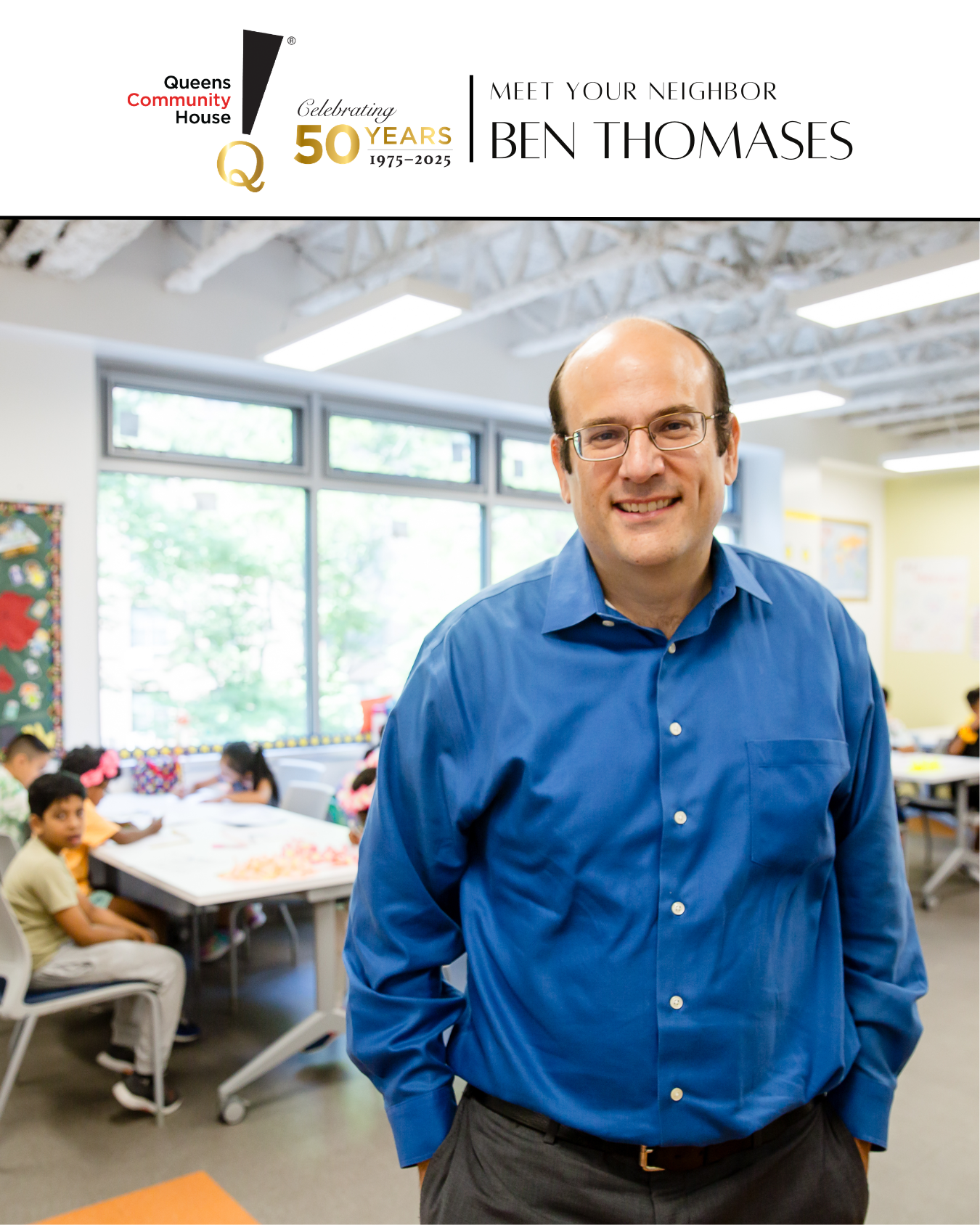
Our final 50 for 50 feature spotlights Ben Thomases, CEO of Queens Community House, on what it means to build community—then, now, and what comes next.
“When I first came to Queens Community House, I had been leading organizations focused on job training and placement. That work is important—but over time, I came to believe that a more holistic approach was necessary to truly improve people’s lives, especially New Yorkers facing the greatest challenges.
That’s what drew me to QCH.
I was inspired by the settlement house model—the idea that real change happens when you meet people where they are and support the full scope of their needs. But more than that, I could see that QCH didn’t just talk about that model—they lived it. There was a genuine commitment, not just in theory, but in practice. And I felt it immediately on the team. At every level of the organization, staff saw themselves as leaders—people who could take initiative, think creatively, and do what it takes to serve their community.
That culture has always been QCH’s strength.
Over the past decade, what I’m most proud of is how we’ve strengthened our ability to fully deliver on that mission. QCH has long had a powerful culture of caring, but like many community-based organizations, it was under-resourced—especially when it comes to the kind of holistic work we believe in. Government funding tends to be siloed: afterschool programs, older adult services, workforce development. But the connective tissue—the work that brings it all together—is often left unfunded.
So much of my focus has been on finding the resources to support that bigger vision.
That’s meant building out initiatives like our Family Support Unit, advancing community-driven efforts, investing in our spaces through major renovations, and strengthening how we engage neighbors through organizing and advocacy. Those are the pieces that make us a true settlement house—and they’re the ones that have required the most persistence to sustain.
Of course, the challenges have been real. Government contracts that don’t keep up with inflation. Program structures that don’t always align with what communities need. And then there are the moments that test everyone—like the COVID-19 pandemic, which hit our communities hard and forced us to adapt in real time, all while demand for our services grew.
At the same time, broader societal challenges—especially around immigration—have deeply impacted the people we serve. At QCH, about half of our participants are immigrants or the children of immigrants. When the national climate becomes more hostile, more divided, that has real consequences in our neighborhoods.
And yet, in the face of all that, I’ve never been more hopeful.
Our organizing and advocacy work is stronger than ever. Our programmatic efforts—from youth development to literacy to community initiatives—are becoming more integrated and impactful. It feels like the different pieces of our work are coming together in new ways, allowing us to move faster and more effectively toward our mission.
At the same time, we can’t ignore the challenges ahead. I worry about a broader shift in our society toward division and individualism—an ‘every person for themselves’ mindset that undermines the very idea of community. But I also believe, deeply, that what we do at QCH is an antidote to that. When we combine care, connection, and collective action, we create something stronger than those forces pulling us apart.
As we close out this 50 for 50 series, I think about the incredible people whose stories have been shared. And the truth is, these 50 stories are just the tip of the iceberg. Every day, there are staff, volunteers, participants, and neighbors making this work possible—quietly, consistently, and with extraordinary impact.
That’s the real story of Queens Community House.
If I had one message for the next generation, it would be simple: join us. However you can. This is an all-hands-on-deck moment. Whether through advocacy, service, leadership, or simply showing up for your community—there is a place for you in this work.
Because building a better, more just, and more connected community isn’t something any one person or organization can do alone. It takes all of us.”
—Ben Thomases, CEO of Queens Community House